 Download appDownload app
In the dynamic world of digital advertising, publishers are constantly looking for ways to make every impression count. One metric lies at the heart of this quest for revenue: eCPM, or Effective Cost Per Mille (Thousand) Impressions).
But what exactly is eCPM? How does it relate to ad mediation, bid prices, and auction dynamics? And how can Pocket FM’s innovative strategies push it even higher? Let’s break it down step by step.
eCPM represents the estimated revenue a publisher earns per 1,000 ad impressions. It serves as a universal yardstick for comparing ad performance across formats, campaigns, and networks.
Formula:
eCPM = (Total Earnings / Total Impressions) × 1000
Example: If you earned $50 from 10,000 impressions:
eCPM = (50 / 10000) × 1000 = 5
This means you effectively earned $5 for every 1,000 impressions.
Revenue Optimisation: Identify placements, formats, or audiences that generate the highest earnings.
Forecasting: Predict income based on traffic patterns.
Benchmarking: Compare ad sources or demand partners on equal footing.
Simply put, a higher eCPM means your inventory is more valuable.
One of the most powerful ways to improve eCPM is ad mediation - the process of managing multiple ad networks to fill your inventory competitively.
When a user triggers an ad request:
The mediation platform (like Google AdMob, ironSource, or MoPub) evaluates multiple ad networks.
It selects the ad with the highest potential yield for that impression.
✅ Waterfall Model (Traditional):
Networks are ranked by historical eCPM or fill rate.
Requests go top-down until one serves an ad.
Limitation: No real-time competition - lower ranked networks may have higher bids that get ignored.
✅ Hybrid Mediation with Real-Time Bidding (RTB):
Combines the waterfall with RTB auctions.
Networks capable of dynamic bidding can compete in real time.
The highest bidder wins, maximising eCPM.
Modern mediation blends these approaches, bringing together guaranteed fill and real-time bidding to optimize revenue.
Bid price is what an advertiser is willing to pay for one impression, calculated in milliseconds based on:
Audience Relevance: Highly targeted impressions command higher bids.
Historical Performance: Past conversions drive aggressive bidding.
Campaign Objectives:
CPC: Ccampaigns focus on clicks.
CPA: Ccampaigns optimise for conversions.
CPM: Ccampaigns prioritise visibility.
Ad Format & Placement: Rewarded videos or high view-ability placements often receive higher bids.
Bid prices - the amounts advertisers are willing to pay for an impression - directly influence your eCPM. The higher the bids competing for your inventory, the more revenue you stand to earn per thousand impressions.
But it’s not just the BID amount that matters - the auction type used to decide the winner plays a big role in your final earnings.
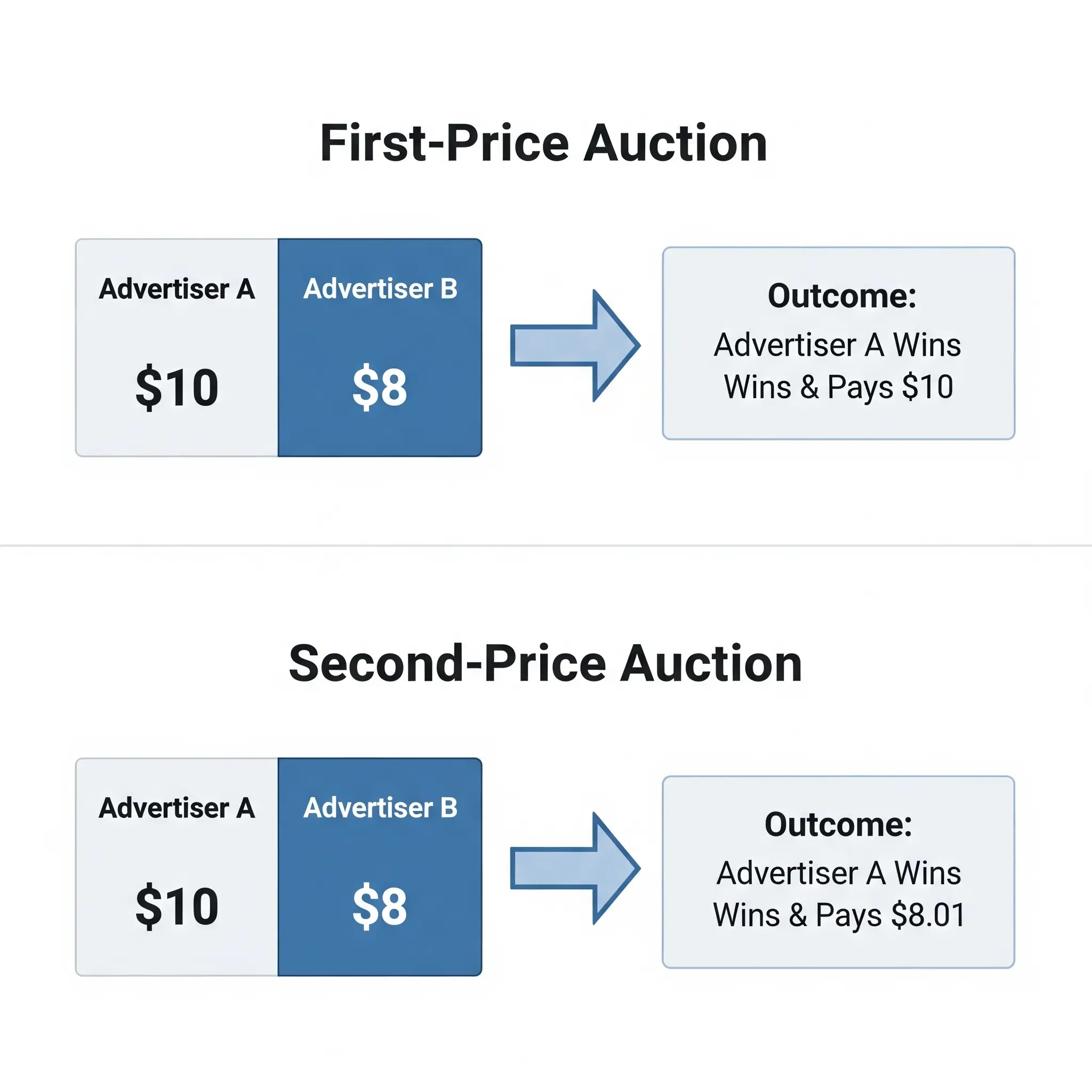
In a first-price auction, the highest bidder wins and pays exactly what they bid.
Example:
Advertiser A: bids $10
Advertiser B: bids $8
Winner: Advertiser A
Payment: $10
Impact on eCPM: You earn the full winning bid amount. Higher bids directly translate into higher payouts. However, advertisers might bid conservatively to avoid overpaying, which can limit overall eCPM growth.
In a second-price auction, the highest bidder still wins, but pays only $0.01 more than the second-highest bid.
Example:
Advertiser A: bids $10
Advertiser B: bids $8
Winner: Advertiser A
Payment: $8 + $0.01 = $8.01
Impact on eCPM: While you don’t receive the top bid amount, having more high bidders still pushes the second-highest price upward. Over thousands of impressions, this competition lifts your average eCPM. Second-price auctions also encourage advertisers to bid their true maximum value, knowing they won’t necessarily pay it.
This is why having multiple demand sources (via mediation) is critical - more bidders mean more competition and better payouts.
At Pocket FM, we apply multiple format-specific and audience-driven strategies to ensure we consistently achieve higher eCPMs while maintaining healthy fill rates:
We capture the maximum historical eCPM an ad has achieved for a specific user.
Based on this, we assign the user to a revenue group.
Ads are then served through mediation optimised for that group - ensuring the user sees higher-revenue ads more frequently without risking ad failures.
Multiple bidding and floor-pricing strategies are tested to consistently show higher eCPM rewarded video ads.
We balance ad frequency with fill rate to maximise total revenue without overloading the user experience.
We serve both static and muted video banner ads, each optimised to achieve higher eCPM.
Algorithms continuously adjust delivery to avoid low-paying impressions and reduce failure rates.
Using personalised bidding strategies, we select only the best-paying interstitial ads while minimising drop-offs.
Optimise monetisation by setting personalised eCPM floors.
Improve fill rates without compromising revenue.
Use cohort-based segmentation to fine-tune pricing strategies for different user groups.
Duolingo partnered with AdMob to optimize their mediation strategy. This upgrade helped Duolingo increase ad revenue by about 70%. When they added bidding on top of mediation, revenue rose another ~20%, and eCPMs across various formats went up by 10-20%. Rewarded ads, in particular, saw a 50% revenue lift and a 2.5% boost in engagement. Reference
Zynga leverages rewarded video strategically through:
Reach-focused entry points: Visible placements such as daily bonus buttons or lobby prompts.
Engagement-focused entry points: Options to watch ads when users need extra lives or in-game currency.
They also implemented app bidding via Meta Audience Network, leading to better fill rates, transparency into demand, and increased operational efficiency. Zynga’s emphasis on using the "right entry point" demonstrates how rewarded video can drive higher eCPMs while balancing IAP and user experience. Reference
Spotify focuses on delivering ads that align with user context and content:
Context-based audio ads: Ads pitched to match listening context—e.g., a swimsuit ad during a beach playlist or sneakers in a workout session—ensuring relevance and listener engagement. Reference
Here are proven tactics publishers use to boost eCPM:
Auto eCPM Optimisation: Platforms auto-adjust network rankings based on recent performance data.
Floor Pricing: Set minimum acceptable bids to avoid underselling impressions.
Header Bidding: Allow multiple demand sources to bid simultaneously before your ad server decides who wins, increasing competition.
Ad Format Diversification: Video and rewarded ads often command higher eCPMs — incorporate them where possible.
Audience Segmentation: Niche audiences with high intent attract premium bids.
Viewability Improvements: Place ads in prominent areas for better engagement and higher earnings.
eCPM isn’t just a number — it’s a roadmap to revenue growth.
At Pocket FM, we’ve proven that personalisation, format-specific optimisation, and smart mediation lead to higher payouts and stronger ad fill.
By understanding:
How mediation platforms create competition,
How bid prices are calculated,
And how auction mechanics impact payouts,
you can make smarter decisions to maximize every impression’s value.
Whether you’re using traditional waterfalls, hybrid mediation, or advanced header bidding, your goal remains the same: to raise eCPM, improve fill rates, and grow your ad revenue sustainably.
Harness the power of mediation, data-driven optimisation, and diversified ad formats. Every impression is an opportunity — make sure you’re getting the most out of it.