 Download appDownload app
In early 2026, a new audio drama quietly appeared in the Autoplay queues of Pocket FM listeners. The show was called Signed & Bound. It featured a “Strong Female Lead” in a romance and drama setting, a trope that hadn’t previously had strong representation on the platform. There was no marketing campaign behind it. No editorial team had hand-picked it for promotion. No influencer had talked it up. By the end of the month, it had generated $$$ in revenue.

Autoplay is Pocket FM's end-of-content queue: when a listener finishes a show or runs out of unlocked episodes, the next one simply starts. No searching, no scrolling, the content arrives. And in this case, it arrived at scale, to the right listeners, with no human direction whatsoever.
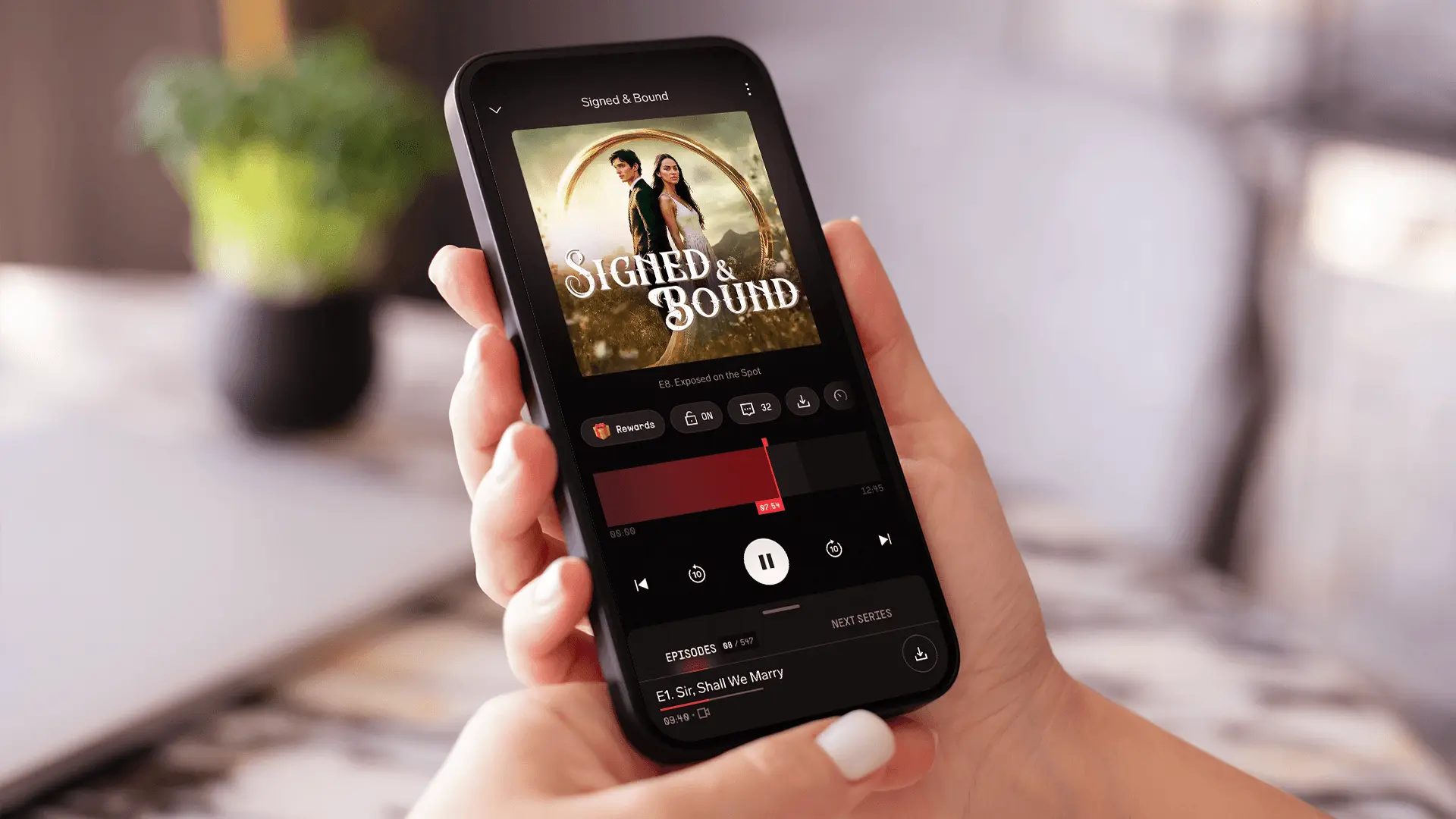
A sample of Player Screen with next series powered by Autoplay That result raises an obvious question: how did the system know?
Audio streaming platforms have a deceptively simple optimization target: get users to listen more. The more time someone spends in your app, the better. Or so the thinking goes.
But this creates a subtle and expensive trap.
Not all listening is equal. A user who spends hours consuming freely available content they’ll never pay for looks, on the surface, identical to a user who is deeply engaged and on a path to becoming a long-term subscriber. A recommendation engine that optimizes purely for raw listening time treats both users the same,and in doing so, it actively works against its own business goals. It will surface content that drives volume, not value. It will grow your playtime numbers while quietly hollowing out your revenue.
The harder question, and the one Pocket FM’s data science team set out to answer, is this: can you teach a recommendation system to tell the difference?
The insight that unlocked this was deceptively simple: the value of a user’s actions today is not equal. And each action tells you something different about the future.
Consider the range of ways a listener can engage with a show on Pocket FM. They might return daily, building a consistent listening habit around a show. They might binge multiple episodes in a single sitting, a signal of deep, immediate pull. They might watch ads to unlock an episode, willing to invest effort to continue. They might spend coins they’ve purchased to keep a story going. Or they might be a subscriber, unlocking content as part of an ongoing commitment to the platform. A user's journey is made up of many such Core Actions, each telling a different story.
The question Pocket FM’s team asked was: what is the value of each of these actions today, relative to what a user is likely to generate in the future? Across the full picture of how a user consumes a show, not just how much they listen, but how, the system builds a view of how responsible each type of engagement is for that user’s future. That framing: the weighted value of current behavior against future value, is what we call Weighted Playtime, and it sits at the heart of the system.
Predicted User Value = F (w₁: Binge Listening, w₂: Daily Habit, w₃: Subscription Usage, …) |
|---|
Each weight (w) is learned from historical data on what actually predicts long-term core user and business metrics — not assumed, not hand-tuned.
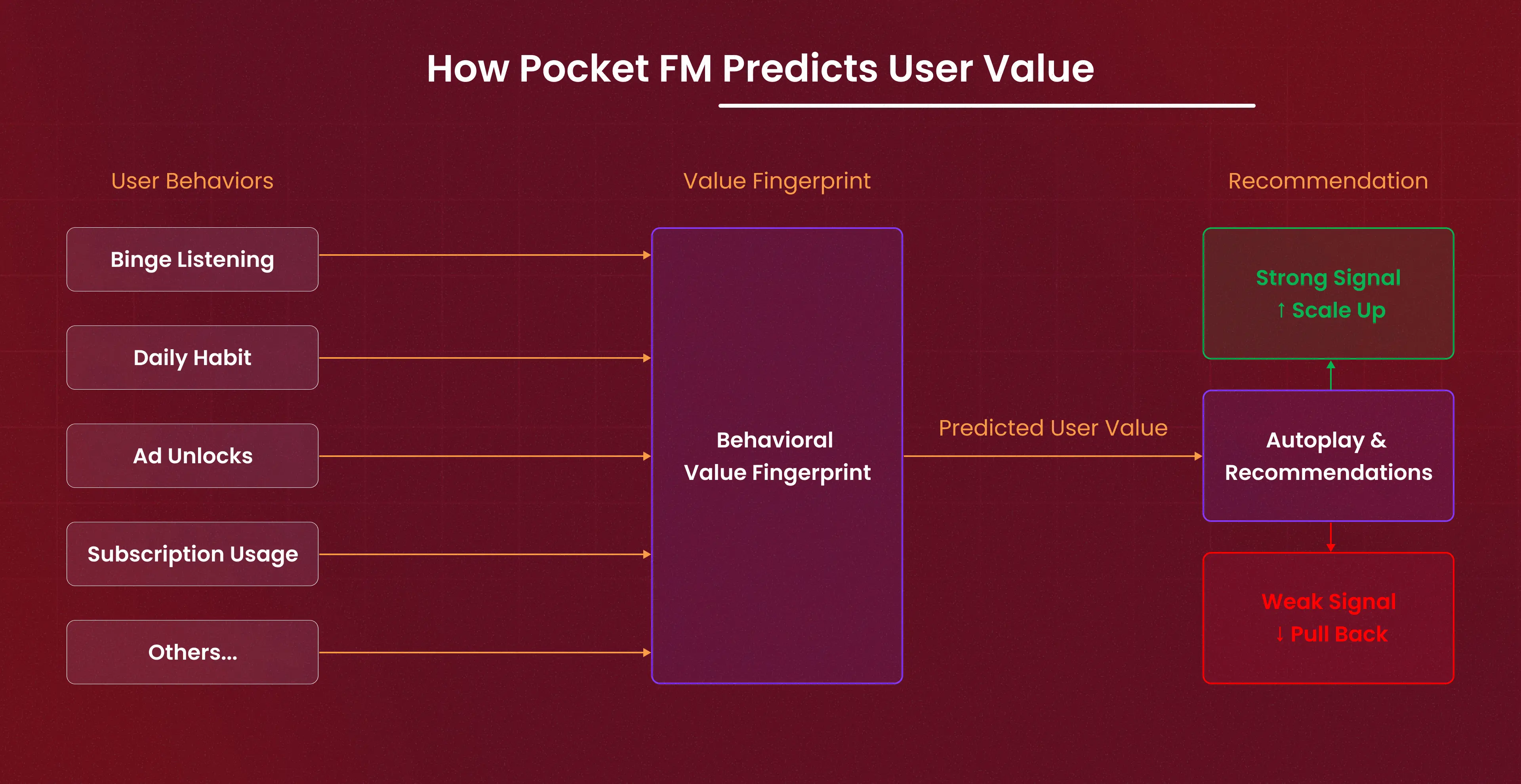
Rather than treating all listening as a single undifferentiated signal, the system learns to weight each type of engagement by how strongly it predicts core user and business metrics. The result is what we think of as a behavioral value fingerprint: a read of how a user is engaging today that tells you something meaningful about who they’re likely to become.
The mechanics stay proprietary, but the logic is straightforward: if you know that certain engagement patterns are consistently followed by higher long-term value, you can use that knowledge to make better decisions right now. Not just about what to recommend to a given user, but about which content is worth amplifying across your entire platform.
This is the signal that feeds Pocket FM’s recommendation engine.
Most recommendation systems, at their core, are popularity amplifiers. They identify what’s already working, what users are clicking on, listening to, finishing, and serve more of it. This works reasonably well for established content. It fails badly for anything new.
A show that launched last week has almost no behavioral history. A standard recommendation engine has almost nothing to work with, so it defaults to safer, more established titles. The result is a feedback loop: popular shows get recommended more, accumulate more data, and become even more dominant. New content struggles to break through regardless of its actual quality.
Pocket FM’s system breaks this loop. Because it’s optimized on the quality of engagement rather than its volume, it doesn’t need a show to already be popular to surface it. It needs early listeners to engage with it in ways that match the behavioral profile of high-value content. When that signal appears — even in a small sample of early listeners — the system treats it as meaningful and begins to amplify it.
This is why Signed & Bound got discovered at scale before any human process would have found it, and why it kept scaling once it did. The model saw a behavioral signal that predicted future value, acted on it, and the signal kept holding.
Shows like The Eclipse Princess and Seventh Seal followed the same pattern: each identified, propagated, and validated by the system before conventional discovery channels would have reached them. The model didn’t wait for a show to become popular. It found the ones that deserved to be.
The clearest way to describe what changed is this: the gap between “a good show exists on the platform” and “listeners are finding it” collapsed dramatically.
Where that process previously unfolded over weeks, relying on editorial curation, manual testing, and organic word-of-mouth, it now happens in days. The system surfaces promising content early, tests it against the right audiences, and scales distribution quickly when the signal holds. When it doesn’t, it stops. The speed and precision of this loop is something that’s genuinely difficult to replicate without the underlying behavioral data to drive it.
The chart below shows the effect on Autoplay revenue since launch -
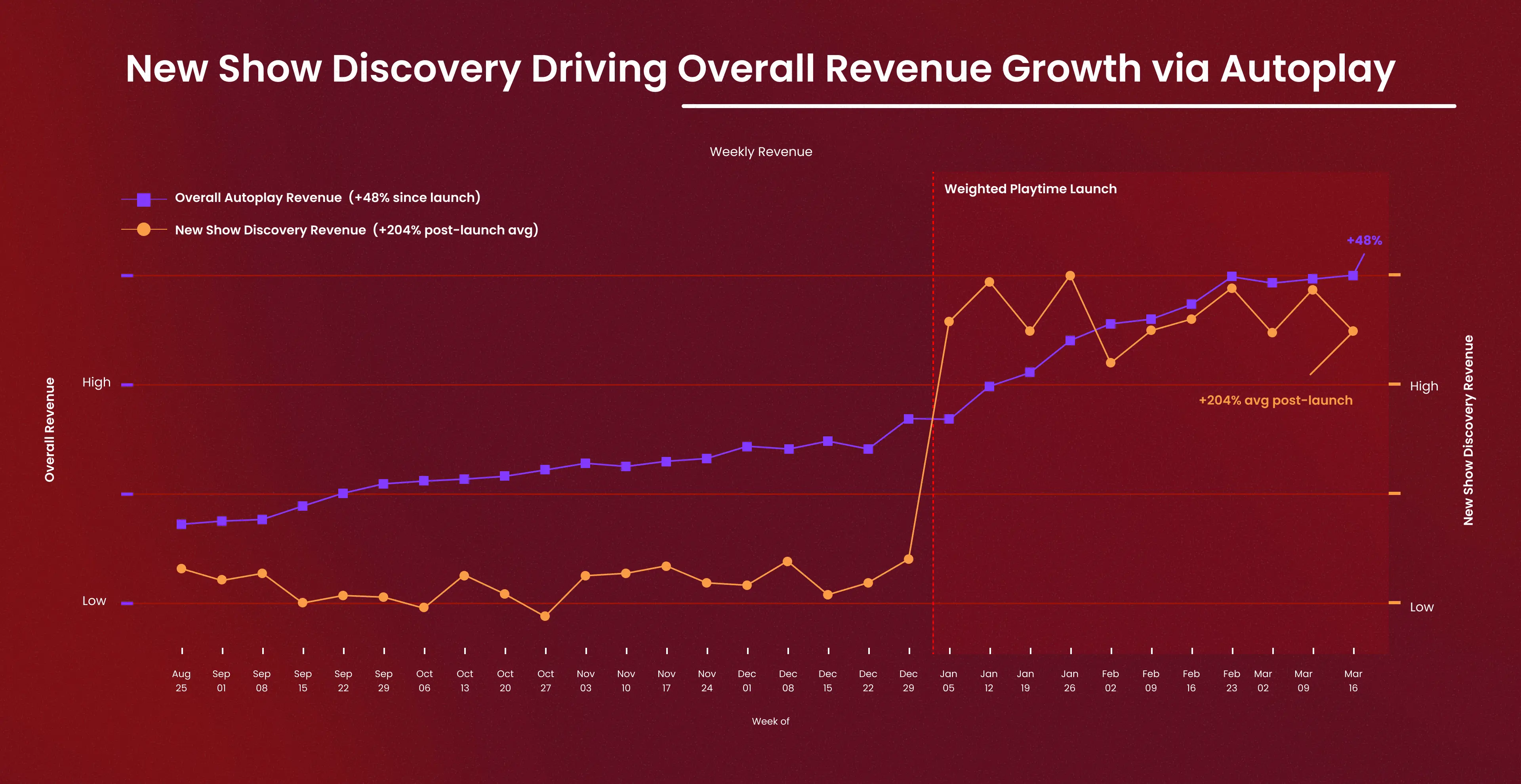
The model doesn’t just recommend. It discovers.
Recommendation systems tend to get better with scale:more users, more content, more behavioral data to learn from. What makes Pocket FM’s approach interesting is that the feedback loop compounds in both directions. As the platform grows, the system gets better at identifying valuable content early. As it gets better at identifying valuable content early, more creators find a meaningful audience faster. The platform and the catalog co-evolve.
At Pocket FM, the best show you’ve never heard of is exactly the one we’re trying to find for you.