 Download appDownload app
Every content platform eventually hits the same wall. A new show with 400+ episodes lands — early metrics look promising, but no one on the team has read past episode 50. Meanwhile, a long-running hit with 600+ episodes is quietly losing listeners past episode 300, and nobody can explain why without reading the whole thing. These aren't edge cases. This is the permanent reality of managing a catalog at scale.
Canon was built to solve this for good — a system that gives a content team the depth of understanding that comes from reading every episode, for any show, without anyone actually reading it. Story arcs mapped, character trajectories traced, narrative weak points identified, season breaks recommended. In under an hour.
The name is deliberate. In entertainment, canon means the official, established facts of a story universe — who the characters are, what events have happened, the world-building rules, the timeline. Canon the system does exactly that: it ingests every episode, builds the definitive record of a show's universe, and makes it queryable. The single source of truth for a show's narrative, programmatically enforced.
Content platforms live and die by their catalogs. New shows arrive every week — serialized fiction, audio dramas, long-form stories across every genre — each potentially hundreds of episodes long. But the challenge isn't just evaluating what's new. It's understanding what you already have. A catalog of thousands of running shows is an asset only if someone knows what's actually in them.
The questions are the same whether a show is new or five hundred episodes deep: Where does the narrative hook land? How sustainable is the premise? Are the character arcs earned or repetitive? Where should the season breaks go? Is the quality holding up, or is a once-strong show quietly losing its edge?
Traditionally, this meant one of two things. Either an editor read the entire show — weeks of work for a long-running series — or the team made decisions based on surface-level signals: genre tags, early episode samples, listener metrics without narrative context. The first approach doesn't scale. The second approach misses.
The question Canon set out to answer was: can you give a content team the depth of understanding that comes from reading every episode — for any show, new or running — without anyone actually reading it?
Summary — 10x condensed. Parallel workers extract structured summaries from every episode: plot events, characters, power systems, cliffhangers, and notable dialogue. Each group receives the previous group's output as context, maintaining narrative continuity across the entire show. A character introduced in episode 12 is still tracked through episode 340. For a 1,000-episode show, this compresses 238,000 tokens of raw text into roughly 24,000 — without losing narratively significant detail.
Build data attributes. From the condensed summaries, the system extracts dozens of structured attributes: story arcs with episode spans, character presence maps, throughline progression curves, cliffhanger intensity scores, genre radar data, trope strength ratings, and first-20 hook classifications. This is where raw narrative becomes queryable, comparable data.
Generate insights. A single synthesis pass produces deep structural analysis: premise sustainability rating, season packaging with narrative-driven breaks, character development gaps, comparable title mapping, and an actionable verdict with rationale. The report and the data come from the same analytical call, so they're inherently consistent.
Dashboard & report. Everything surfaces as an interactive dashboard and a structured analysis report. One package, ready for a decision-maker — no reading required.
The reason Canon produces analysis that a content team actually trusts — rather than the shallow summaries most AI tools generate — comes down to a single design choice: separate compression from judgment.
Most approaches try to do both at once: throw raw text at a model and ask for a verdict. That fails for serialized content because no model can hold 500 episodes in context simultaneously, so it either samples (and misses the subplot that pays off 300 episodes later) or summarizes so aggressively that the nuance evaporates before any real analysis begins.
Canon inverts this. The early stages are purely about compression with continuity — reducing volume while preserving every narratively significant detail and maintaining the thread of who did what and when. Judgment only enters at the synthesis stage, when the compressed material is small enough for a single analytical pass but rich enough to support real conclusions.
The model making the analytical recommendation has access to the entire show's narrative structure, not a lossy sample of it. That's why it can tell you that a show's premise is sustainable through episode 400 but starts to strain by episode 450 — it has actually seen both.
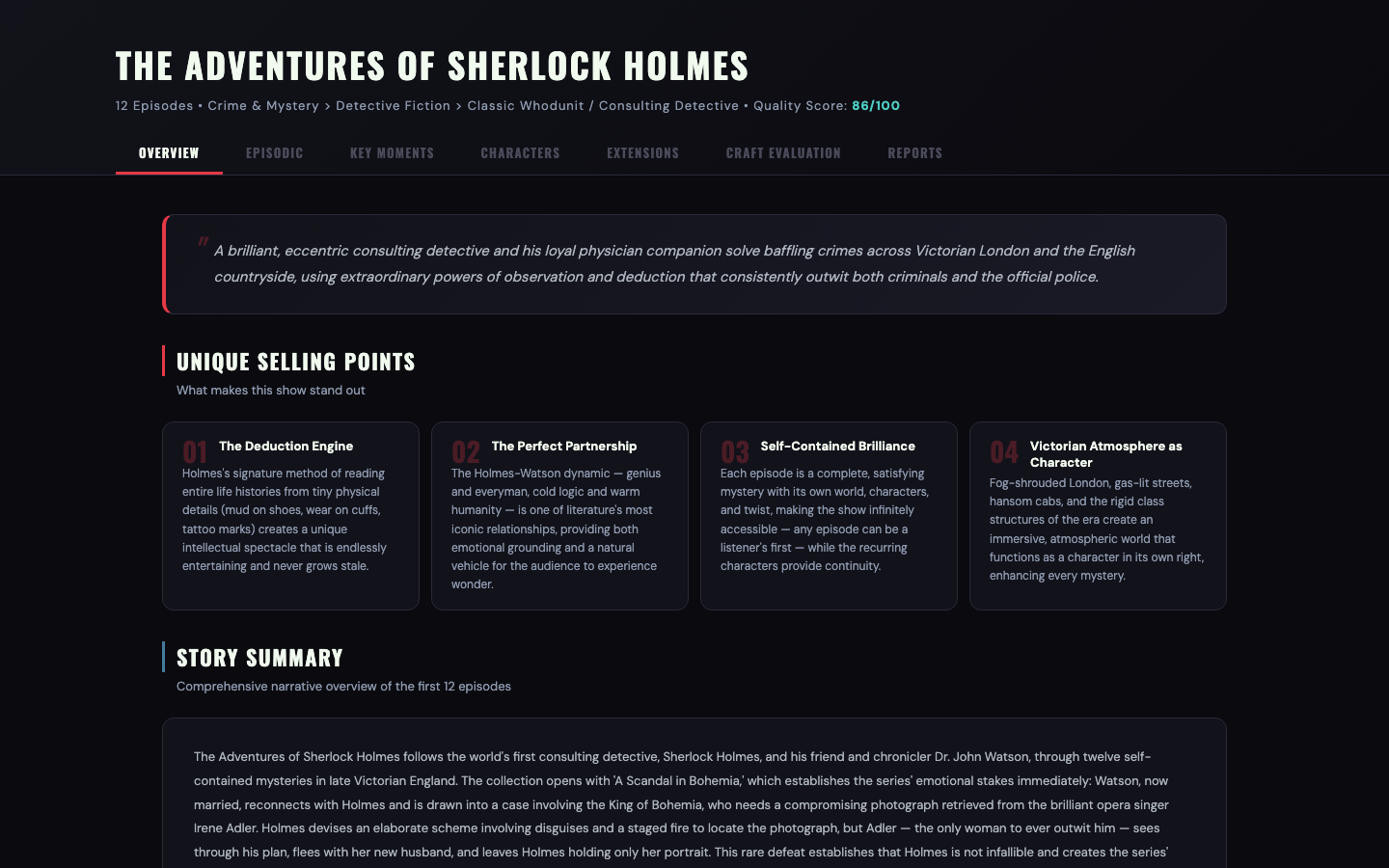
To make this concrete, here's what Canon produced for The Adventures of Sherlock Holmes — twelve episodes analyzed, zero human reading required.
Canon is built on large language models with million-token context windows. This system could not have existed two years ago — it's possible now precisely because AI got better in the two ways that matter for this problem: models that can actually comprehend narrative, and context windows large enough to hold an entire show.
The content understanding problem has always been a comprehension problem. Older NLP tools could count things: word frequencies, sentiment scores, entity mentions. They could tell you a character's name appears 200 times across 400 episodes. What they could never do is tell you what happens to that character — that their arc peaks in episode 85, stalls through a repetitive stretch from 120 to 180, and resolves in a way that quietly undermines the show's central premise.
That kind of analysis requires the ability to read a passage of text and understand its narrative meaning. Not its keywords. Its meaning — who wants what, what's at stake, how this scene connects to a scene 200 episodes earlier, and whether the payoff lands. LLMs brought comprehension; million-token context windows brought the ability to hold an entire show's compressed narrative in a single analytical pass. Canon needs both.
The output is structurally consistent across shows, which means content decisions can be compared on common axes rather than relying on the subjective framing of whichever editor happened to evaluate each one. A head of content doesn't read a 40-page report to understand a show's arc structure — they see it in a chart in seconds. A season-packaging recommendation isn't a paragraph buried on page 30; it's an interactive card with episode ranges and cliffhanger descriptions.
The hardest part of managing content at scale was never making decisions. It was knowing enough about what you have — and what just arrived — to make them with confidence. That's what Canon provides: not the decision itself, but the depth of understanding that makes every content decision defensible.